Threat library
More than 14 ready templates, from infotainment and telematics to braking, battery management, keyless entry and EV charging. Add one to a project in a click.
 oxTARA
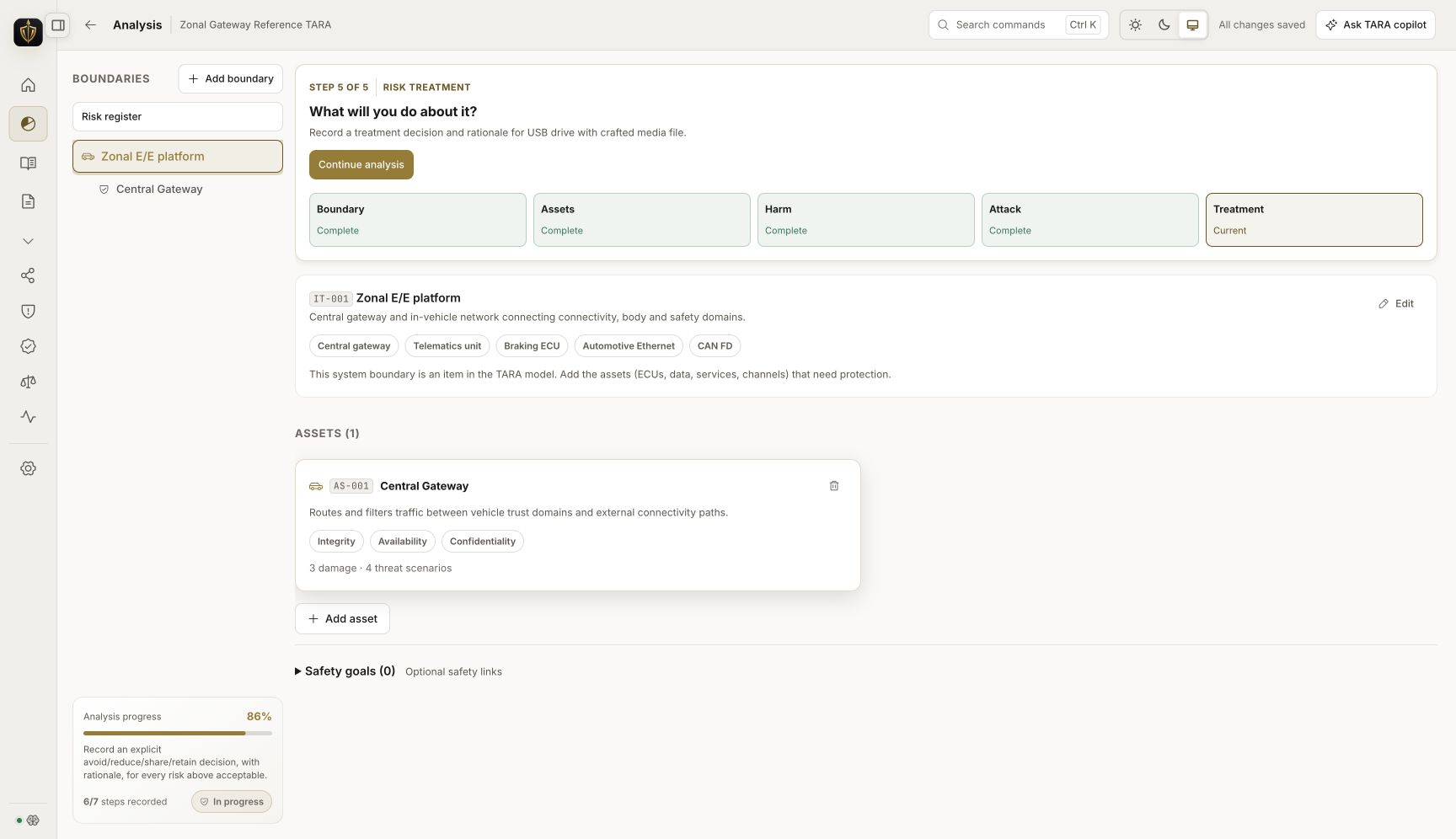
 is a desktop workbench for automotive Threat Analysis and Risk Assessment, following ISO/SAE 21434. It walks an engineer from item definition to treatment decisions, keeps every rating traceable, and works fully offline.
Try the risk calculator See the workflow
Private preview, version 0.2.0. Installers for macOS and Windows; Linux builds from source.
This is the calculation oxTARA runs for every attack path, with its default 5×5 matrix. Move the sliders and watch the risk value change.
Impact value, 1 to 5, left to right. Attack feasibility, 1 to 5, bottom to top.
3
Medium risk
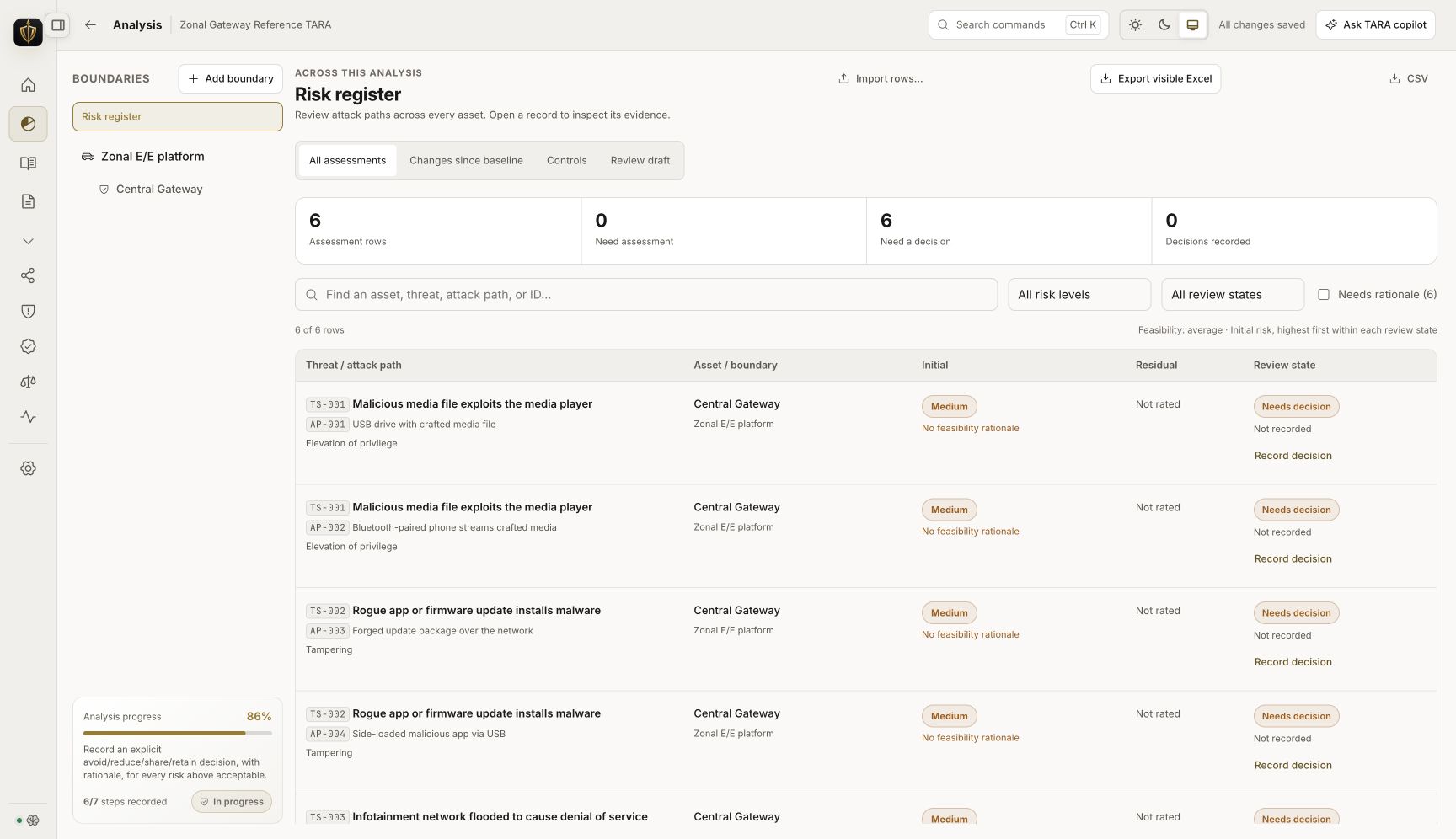
Every record on the way carries a stable reference, such as AS-001 or TS-002, that follows it into the register, the exports and the report.
Name the system and draw its boundary.
List what needs protecting: controllers, data, services, channels.
Rate the harm across safety, financial, operational and privacy.
Work through STRIDE for each asset.
Describe how an attacker gets there, step by step.
Rate each path on the five standard metrics.
The matrix combines impact and feasibility into 1 to 5.
Avoid, reduce, share or retain, with a recorded rationale.
More than 14 ready templates, from infotainment and telematics to braking, battery management, keyless entry and EV charging. Add one to a project in a click.
Every attack path across every asset in one filterable table. Export to Excel or CSV, or import an existing register and preview every row first.
Draw the vehicle's data flows with automotive stencils and trust zones. A versioned rule pack proposes STRIDE threats you can review and insert.
Executive, engineering, assurance and supplier editions compiled from the live model, exported as Word, PDF, Markdown or JSON, with claim-level source tracing.
Drafts assets, scenarios, attack paths and mitigations with OpenAI-compatible, Anthropic, Gemini or local Ollama models. Every generation is kept in an evidence ledger for an engineer to accept or reject.
An ISO 26262 concept-phase workbench: hazardous events, severity, exposure and controllability, and the resulting ASIL, linked to the cybersecurity damage scenarios.
Compare today's analysis with a sealed baseline, see exact before and after values, and find treatment decisions that may have gone stale.
Fetch the day's advisories from OSV.dev for every component in the bill of materials that has a package URL. No API key needed.